Calling In Framework
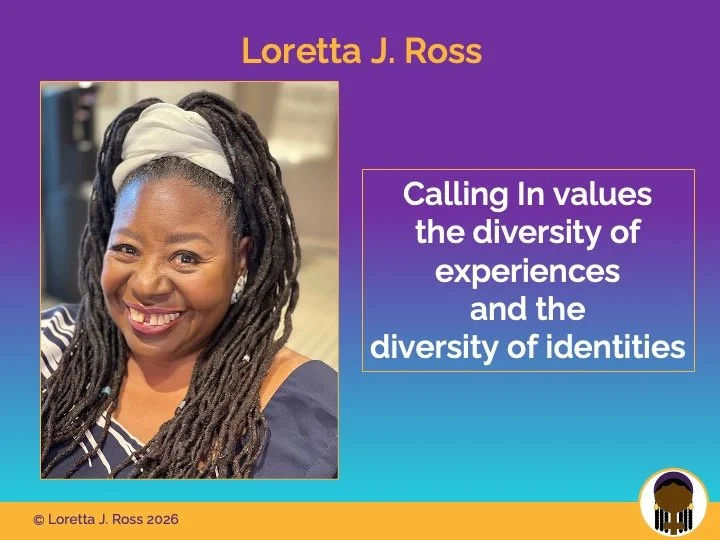
Calling In values the diversity of experiences and the diversity of identities.
Dismayed by cancel culture and how eager we were to dispose of anyone who made a mistake, I sought an alternative. In my search, I came across the term “Calling In,” coined by Ngọc Loan Trần, which captured what I had been trying to articulate myself: a way to communicate that would allow us to reach out and connect even in times of harm. This inspired me to build out a framework for what Calling In means in practice and to show how and why it is crucial in today’s human rights movement . Over the past six years, I have taught this framework to thousands and even written a book about it. I share some of the basics of the Calling In framework below.
The 5Cs Continuum
It is impossible to be in relation with each other and not cause harm, despite our best intentions. Unfortunately, it means we also will be harmed at some point. How we move forward in those moments is a key decision point for how we want to approach our interactions. We can heal our relationships and show up with our best intentions. Our ability to communicate individually also affects how we work within teams, organizations, and contribute to movements.
The 5Cs Continuum within my Calling In framework shows five options to make strategic decisions during conflict or difficult moments.
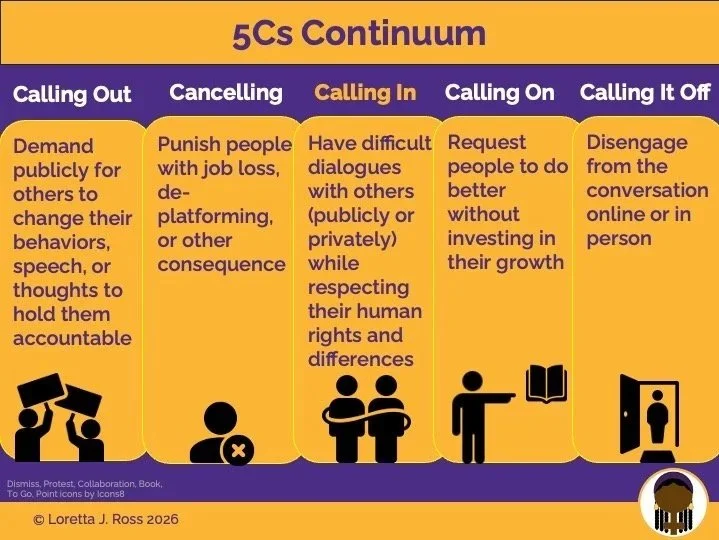
The 5Cs Continuum: Calling out, Cancelling, Calling in, Calling on, Calling it Off
Calling Out: Public demands for others to change their behaviors, speech, or thoughts to hold them accountable. “I can’t believe you just said that to me!”
Cancelling: Punishing people with job loss, deplatforming, or other consequences. “Let me speak to your manager.”
Calling In: Private or public skills for having difficult dialogues with others while respecting their human rights and our differences. “I’m not sure what you meant by that. Can you say more?”
Calling On: Requesting people to do better without investing in their growth. “I beg your pardon? Are you OK?”
Calling it Off: Disengaging the conversation. “I can’t do this right now.”
Which of these do you reach for most often? Pattern recognition in yourself is key to understanding how to make a change. Consider which option might be best in your situation, which is not necessarily the one you’re most comfortable or familiar with.
Note: These can be used in person or online.
Calling In is a Call Out
Done with Radical Love
With Calling In, we can:
Achieve accountability with grace and forgiveness
Match your passion with compassion
Invest in each other as members of the human rights movement
Offer everyone an opportunity to self-reflect, apologize, repair, and change behavior
Remember the bigger picture and long-term vision
Encourage a spirit of curiosity and generosity
Use active, loving listening practices
Align our actions with our integrity
How to make the strategic choice to call in
As you approach this decision, take a pause. Calling In starts with YOU, so we have to call ourselves in first. Consider what’s going on within you before you try to connect (or project it) with someone else.
How am I?
Am I tired? Do I have the energy for this conversation now? Am I feeling activated, embarrassed, annoyed? Have I forgiven myself for conflicts I have been part of in the past?
Whom am I speaking to?
I go into much more detail about what I term Spheres of Influence (pp.85-95 of Calling In: How to Start Making Change with Those You'd Rather Cancel) but a good starting place is to ask: What relationship do I have with this person? What do I know about what they value? How they communicate? What are the power dynamics at play?
What outcomes do I envision?
What will be different as the result of our conversation? What do I want? New boundaries? New expectations? Agree to disagree? Have I accepted that I don’t have the power to change others, but can always offer love and respect?
I want to call in…But HOw?
Recognize that there is no one-size-fits-all perfect phrase. There is no way to know how anyone will react when you speak. You can only control yourself and your words. Lean into the moment and a desire for true connection. All you need to be ready is to choose empathy and curiosity over presumptions and a need to be right.
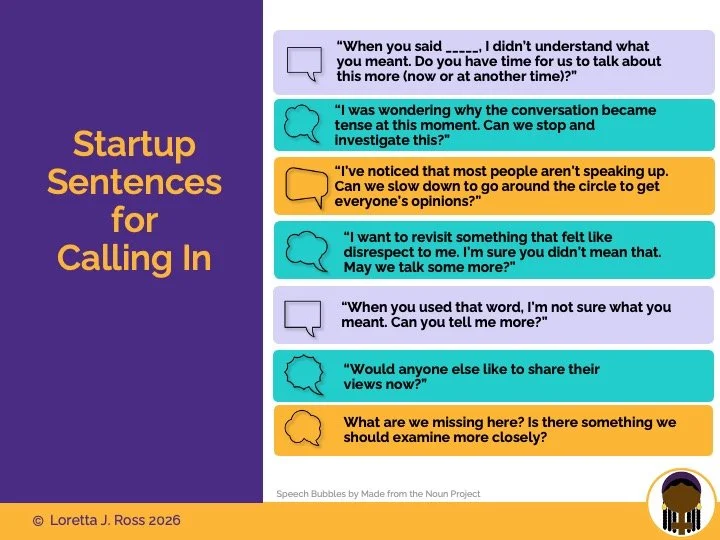
Startup Sentences for Calling In
Adapt these example startup phrases for your situation and set the tone for a call in:
“When you said _____, I didn’t understand what you meant. Do you have time for us to talk about this more (now or at another time)?”
“I was wondering why the conversation became tense at this moment. Can we stop and investigate this?”
“I’ve noticed that most people aren’t speaking up. Can we slow down to go around the circle to get everyone’s opinions?”
“I want to revisit something that felt like disrespect to me. I’m sure you didn’t mean that. May we talk some more?”
“When you used that word, I’m not sure what you meant. Can you tell me more?”
““Would anyone else like to share their
views now?”“What are we missing here? Is there something we should examine more closely?”
What to Do if You’re
Called Out/In/On
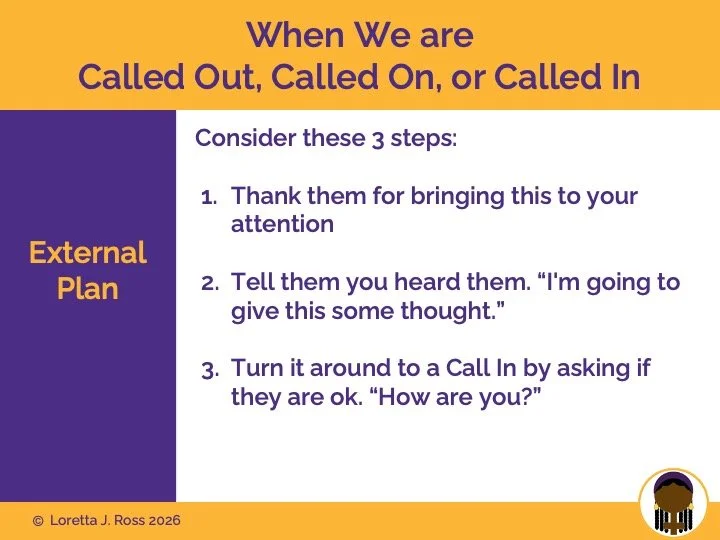
When we are called out, called on, or called in
Call yourself in first!
Are you feeling defensive? Shameful? Relieved?
Having an emotional reaction is normal, but recognize that your reaction is yours to handle before you engage with the other person.
Then, consider these three steps:
Sincerely thank the person calling you for their time and attention because that is a precious gift because they’ve shown you that you’re signficant and matter to them.
Let them know you have heard them e.g., “I will take it into consideration.” This assures them of their significance and importance to you.
Turn their call out into a call in by asking how they are doing and why they chose that tactic of getting your attention. This shows your empathy, that you care about them as well as yourself.
If applicable in the moment, apologize and commit to change. Check out: Franchesca Ramsey’s Getting Called Out: How to Apologize
Sign up to my mailing list to be first to hear about our affordable ($5 a class!) online course or reach out if you’re interested in a customized training for your organization.
FURTHER RESOURCES
Loretta J. Ross | Don’t Call People Out -- Call Them In” (TED Talk)
Loretta J. Ross | Calling In: How to Start Making Change with Those You'd Rather Cancel
Loan Tran | Calling In: A Less Disposable Way of Holding Each Other Accountable
Sonya Renee Taylor | Beyond Call-outs and Call-ins: Let’s Call On
Natalie Wynn (Contrapoints) | Canceling